
Anthropology/Sociology
Program Synopsis
The demand for postgraduate programmes in Social Sciences (Anthropology/Sociology) with a focus on policy-oriented research is growing, in line with the national need to understand and address complex societal issues such as social inequality, climate change, community development, food security, and community-based governance.
National and international policy documents such as the National Climate Change Policy (NCCP 2.0), the National Anti-Corruption Plan, and the Sustainable Development Goals (SDGs) emphasise the need for interdisciplinary expertise capable of integrating social science with evidence-based public policy formulation.
This programme differs from conventional sociology or anthropology programmes as it offers a policy research approach that is both cross-disciplinary and contextual. It combines critical theoretical analysis, advanced qualitative and quantitative methodologies, and grassroots community engagement along with stakeholder participation in the research process.
Through this approach, graduates are not only skilled in academic social research but are also equipped with competencies in policy analysis, community advocacy, public communication, and the ability to build networks with government agencies, civil society organisations, industry, and international bodies. This significantly enhances graduates' employability in the public sector, research institutions, NGOs, and regional and global development organisations.
Research Programmes / Graduate opportunities include:
- Micro Credit and Poverty Studies
- Ethnicity and Identity
- Development Sociology
- CSR (Corporate Social Responsibility) and Philanthropy
- Multi-religious and Multi-cultural Studies
- Social Anthropology
- Critical Policy Research
Education, Learning, And Course Outcomes
There are 3 main components that are given high attention in CPR when developing academic programs, namely Program Educational Objectives (PEO), Program Learning Outcomes (PLOs), and Course Learning Outcomes (CLO).
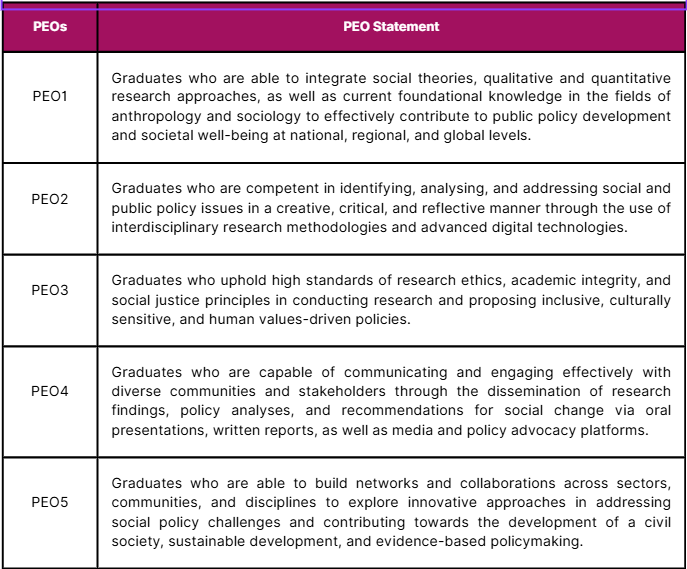
The PEO is a list of target achievements for each student from the program after graduation. For this programme, there are 5 PEOs that have been established to ensure that graduates are well-equipped to drive innovation, foster sustainability, and provide leadership within diverse organizational and societal context. Table 1 lists the PEOs of this programme.
Table 1: PEO of Master of Social Science and Doctor of Philosophy in Anthropology and Sociology
There are 3 main components that are given high attention in CPR when developing academic programs, namely Program Educational Objectives (PEO), Program Learning Outcomes (PLOs), and Course Learning Outcomes (CLO).
The PEO is a list of target achievements for each student from the program after graduation. For this programme, there are 5 PEOs that have been established to ensure that graduates are well-equipped to drive innovation, foster sustainability, and provide leadership within diverse organizational and societal context. Table 1 lists the PEOs of this programme.
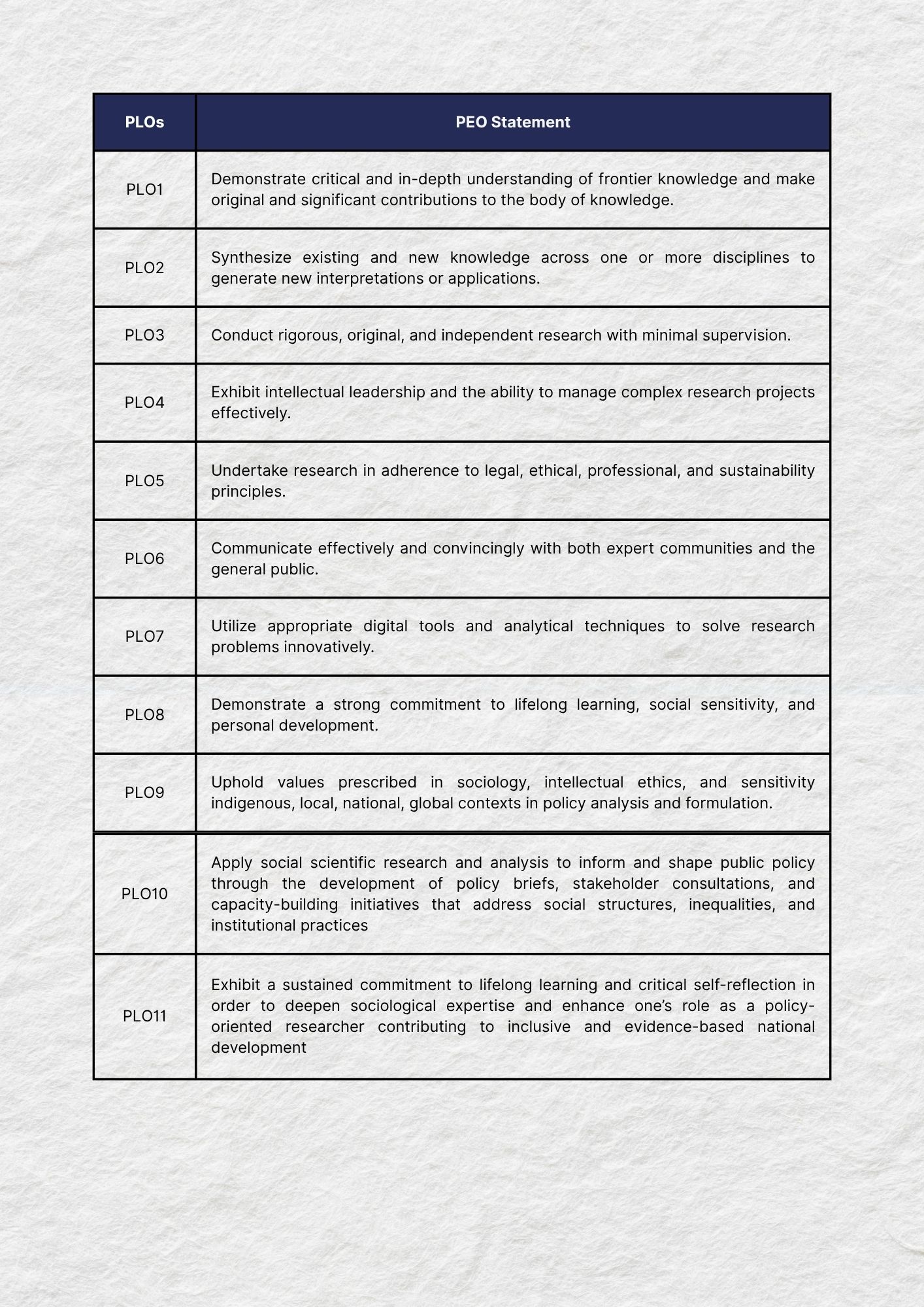
Table 2: PLOs of Master of Social Science and Doctor of Philosophy in Anthropology and Sociology
Course Learning Outcomes (CLOs) for the Research Methodology course outline the specific competencies students are expected to achieve upon successful completion of the course. These outcomes will be clearly communicated and explained by the course lecturer at the beginning of the course.