
“Global Futures Forum” : Thailand’s Muslim Community and Sustainable Development: 4 Future Scenarios in Pluralistic Society of Isan
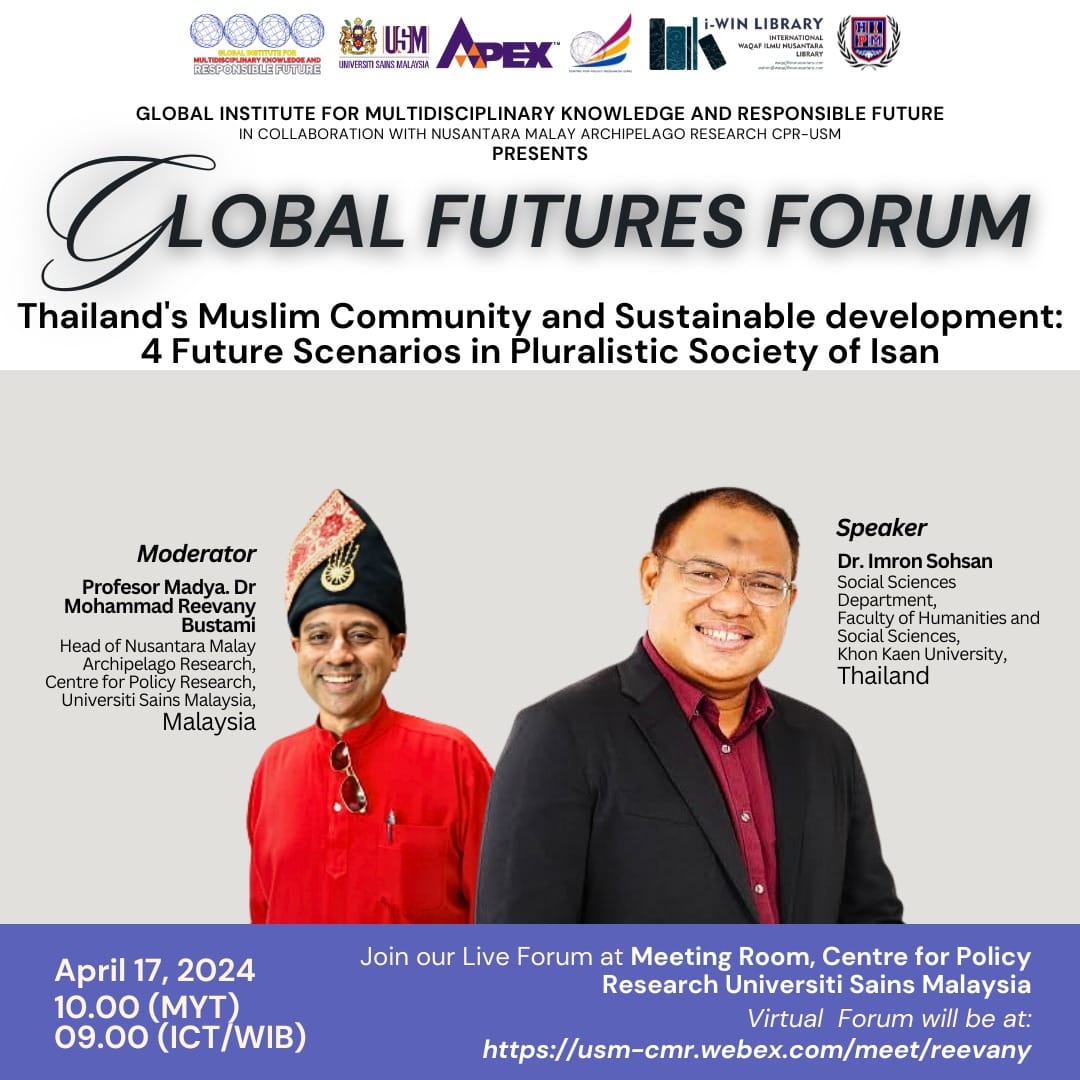
“Global Futures Forum”
Thailand’s Muslim Community and Sustainable Development: 4 Future Scenarios in Pluralistic Society of Isan.
On April 17, 2024
Imron Sohsan, PhD
Social Sciences Department,
Faculty of Humanities and Social Sciences,
Khon Kean University, Thailand,
Imron’s presentation investigates the sustainable development of Al-Mubarak Community, a minority Muslim community sited in a majority Buddhist village setting in the Isan region of Thailand. Since its establishment in 1995, the community has evolved to be a thriving Muslim community nested within a multi-cultural, multi-ethnic and predominantly Buddhist community setting. Muslims and Buddhists affirmed the close, respectful, and harmonious relationships that characterised “their” community, in contrast to inter-religious group tensions and conflicts in other communities in the broader ASEAN region and the Southern Provinces of Thailand, in particular. The community was not just a community for Muslims, but also for other people of different faiths and backgrounds. The strength of Muslim women’s leadership was an unusual finding in terms of other Muslim Thai and international communities and deserves future research focus for that reason. Given global, regional and national Islamophobia and religious tensions, this study showed a positive faith-based model can promote understanding and the creation of sustainable inter-faith community living.
My study found that four scenarios reflected the uniqueness of sustainable development for Al-Mubarak Community:
1) measuring up to the spiritual aspect of sustainable development,
2) dealing with the onslaught of urbanisation
3) sharing constructive contributions for the sake of broader society, and
4) initiating educational opportunities for the next generation.
It was the idea that Al-Mubarak Community needed to think more about what had been achieved and what had failed since its establishment. The sustainability of Al-Mubarak Community remained challenging. A process of soul-searching for the future of the community was inevitable and necessary. Indeed, "Such sustainable development needs time to get there, not just an urgent and fast process." Imam Shafei of Al-Mubarak Mosque observed that “sustainable development for Al-Mubarak Community requires the engagement of its new generation, who adore their community”. Furthermore, a sense of a neighbourhood shared between Muslims and Buddhists has played a constructive role in enabling Al-Mubarak Community to move forward sustainably and significantly. The neighbourhood is a solid foundation for the future of Al-Mubarak Community. As Hamidah, a member of the community said about the importance of neighbourhood towards sustainable development for Al-Mubarak Community “Al-Mubarak Community cannot stand firmly for the future without the help and support from our neighbours. They are more important than we imagined.”
In conclusion, The Muslim community cannot be in isolation from the broader community. Most importantly, Al-Mubarak Community has been built on the clear intention foreseen by its first generation which intended for the tiny Muslim community to live together with the majority Buddhist communities in the Isan region in peace and harmony.